
Today’s infrastructure investments shape tomorrow’s sustainability and livelihoods. It is vital that investment decision-making for major projects integrates concerns about social and economic inclusion to ensure that the value delivered from major projects is shared more equitably and with more positive social impacts.
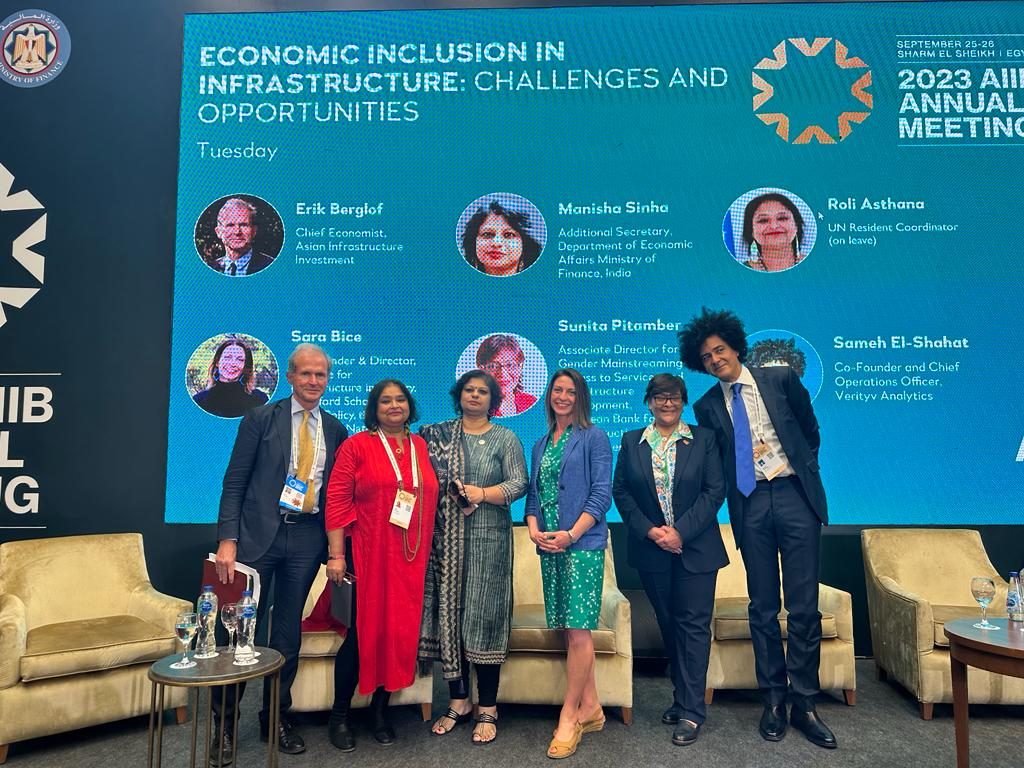
I2S Director Professor Sara Bice joined an international panel to speak about how infrastructure investments can support social and economic inclusion, as an invited guest at the 2023 AIIB Board of Governors’ Annual General Meeting in Sharm El-Sheikh, Egypt.
Chaired by AIIB Chief Economist Prof. Erik Berglof and joined by the UN Ambassador to Uzbekistan, Roli Asthana, Additional Secretary, Dept of Economic Affairs, Ministry of Finance, India, Manisha Sinha, EBRD Director for Gender Mainstreaming, Sunita Pitamber and the COO of Verityv Analytics, Sameh El-Shahat, the panel explored how major infrastructure investment can better support social and economic inclusion, especially of women, children and marginalised groups.
Choices we make about major infrastructure investments are occuring in unprecedented circumstances, characterised by climate change,
geopolitical conflict and financial uncertainty. The estimated $94T in investment needed by 2040* is critical to fostering social and economic inclusion, ensuring that all groups and individuals in a society have equal opportunities for socio-economic participation and development.
Why should inclusion inform infrastructure investment decisions and how can this be done?
Six years of research produced by the Australian National University I2S (Institute for Infrastructure in Society) for Australia’s $187B sector demonstrates a clear business case for inclusion. Our research shows how social concerns, including indigenous and vulnerable peoples, social cohesion, procedural justice and social value creation directly inform project outcomes.
Stakeholder and community pressure is among the top three most influential factors in major project delays and cancellations in Australia.+ This pressure is driven by perceived and realised social risk^–the non-technical project risk arising from community concerns, socio-environmental issues and cultural considerations.** The majority of Australian infrastructure sector professionals we surveyed in 2022 agreed that social risk played a major role in their projects progress or outcomes.+
Perceived levels of social risk have an inverse relationship with levels of resilience in communities and with project acceptance.** The extent to which community members believe projects are delivering desired benefits, including social and economic inclusion, relate directly to levels of resilience and project acceptance.**
Social risk management matters. Yet the vast majority of professionals (81%) manage social risk by intuition, experience and advice.^ Frameworks, including ESFs, are very important starting points. These frameworks, however, lack the necessary detail to guide clients’ delivery of robust, consistent and comparable social data.
ANU I2S is developing world-leading social risk management tools through the support of the Australian Research Council and our industry partners. This starts with our Social Risk Maturity Model (pictured), which defines the four most common approaches to social risk management in the global infrastructure sector and demonstrates that an ‘Integrated and Future Focused’ approach to social risk is necessary to support inclusion and deliver sustainable development aims.
The global infrastructure sector is well-positioned to address social issues through its established principles and frameworks. The groundwork is laid. The next advancement is to implement social risk management to the same rigour and scale as technical risk management.
This could include investing in the development of more systematic, robust and consistent social risk management tools. It could include investment in building social risk management capability across investors and clients.
This investment will ignite fresh thinking and better configure investment decision-making to both improve project efficiency and return on investment through reducing social risk and generating social value in the forms of economic inclusion, resilience and sustainability.
REFERENCES
*GIHub, 2018. Global Infrastructure Outlook.
+Emerson Sanchez, Sara Bice and Kirsty O’Connell, 2023. State of Infrastructure and Engagement: Highlights Report: 2021-2022. Canberra: Institute for Infrastructure in Society, The Australian National University.
^Sara Bice, Hayley Henderson and Kirsty O’Connell (2021). Social risk and Australian infrastructure: Defining an emerging challenge: Social Risk Situation Analysis: Part 1. Canberra: The Australian National University Institute for Infrastructure in Society.
**Sabit Otor, Sara Bice and Kirsty Jones, 2022. Why Community Engagement Matters: Community Resilience and Acceptance in Major Projects. Canberra: Institute for Infrastructure in Society, The Australian National University.